
The 609th plenary session of the European Economic and Social Committee (EESC), held in Brussels on 21–22 October, addressed issues directly affecting workers’ lives: quality jobs, collective bargaining, the impact of artificial intelligence on employment relations, equality and poverty reduction.
The key message of these discussions is clear: European competitiveness is important, but it must not come at the expense of workers’ rights, social protection and decent work.
The Lithuanian Trade Union Confederation (LPSK) is represented at the EESC by Jurga Subačiūtė-Žemaitienė, Vice-Pesdent of the Lithuanian Industry Trade Union Federation.
Collective bargaining – a key part of European employment policy
One of the most important opinions adopted during the session concerned the EU Employment Guidelines (SOC/877). The EESC welcomed the increased emphasis on quality jobs, learning opportunities, collective bargaining and social protection. The Committee also stressed that the use of artificial intelligence and new forms of work must respect workers’ rights.
The Employment Guidelines are important not only at European level. They help shape the European Semester process and recommendations to Member States, meaning that the priorities they establish can also influence national employment policies.
For trade unions, this provides an additional argument for ensuring that collective bargaining is a genuine part of employment relations and that social partners are involved in developing decisions on employment, working conditions and social protection.
The European Semester: social partners must be heard
Discussions on the 2026 European Semester Spring Package (ECO/703) focused on the links between economic reforms, investment and social cohesion. The EESC stressed that Europe must not only set priorities but also effectively implement the objectives already agreed upon, maintaining a balance between economic, social and environmental goals.
The Committee calls for the European Semester to become a more effective tool for achieving sustainable competitiveness, ensuring that reforms and investments deliver tangible benefits for workers, businesses and society.
This is important for workers in Lithuania, too. Consultations with trade unions should not be a mere formality. Workers’ representatives must have a meaningful opportunity to contribute to decisions before they are adopted.
Digital transformation: workers’ rights and data protection
In its opinion entitled “Overcoming digital dependencies to protect workers’ rights and data – EU sovereignty in cloud computing, artificial intelligence and the information society as a democratic imperative” (TEN/878), the EESC highlighted Europe’s dependence on cloud computing, artificial intelligence and digital platform service providers from outside the European Union (EU).
The Committee calls for a common EU digital sovereignty strategy, stronger data protection and safeguards to ensure that technological development does not undermine workers’ rights.
These issues are increasingly relevant to workers as digital tools become more widespread, including algorithms that assess work performance, automated task allocation and employee monitoring. The introduction of new technologies should not take place without workers knowing what data is being collected about them and how it is used.
Trade unions therefore have an important role in ensuring that digital systems are introduced transparently, their impact on working conditions is assessed, and workers’ representatives are involved in decisions concerning these changes.
Competitiveness must not become an excuse to weaken workers’ protection
Discussions on boosting productivity through a more integrated Single Market addressed the obstacles posed by fragmented regulation and bureaucracy. Clearer and more consistent rules can help businesses operate more efficiently, but it is essential to ensure that regulatory simplification does not weaken workers’ protection.
Workers’ voices are also being heard in discussions on industrial policy.
From the trade union perspective, productivity growth and innovation must go hand in hand with better working conditions, skills development and opportunities for workers to share in the benefits of economic progress.
Equality and the inclusion of persons with disabilities – untapped potential
In its opinion “An Equality and Competitiveness Agenda” (SOC/874), the EESC emphasised that equality and economic competitiveness are not mutually exclusive. Removing barriers to education, employment and career progression can help make better use of society’s skills and strengthen the resilience of the European economy.
In discussions on strengthening the Strategy for the Rights of Persons with Disabilities, the Committee called for additional measures to ensure that persons with disabilities can participate in society and the labour market on an equal footing.
This is a reminder that labour market challenges cannot be addressed solely by recruiting more workers. It is also necessary to create opportunities for people who still face barriers to employment and continued participation in the labour market due to inaccessible environments, discrimination or other obstacles.
Tackling poverty – from political commitments to concrete action
During the plenary session, the EESC also adopted the opinion “Anti-Poverty Strategy and Intergenerational Poverty” (SOC/875). The opinion examines the European Commission’s proposed EU anti-poverty strategy and emphasises the need to address the structural causes of poverty, strengthen social protection, ensure access to quality essential services and create an inclusive labour market.
The Committee calls for stronger action at both EU and national levels to reduce poverty and prevent it from occurring, with particular attention to the most vulnerable groups in society.
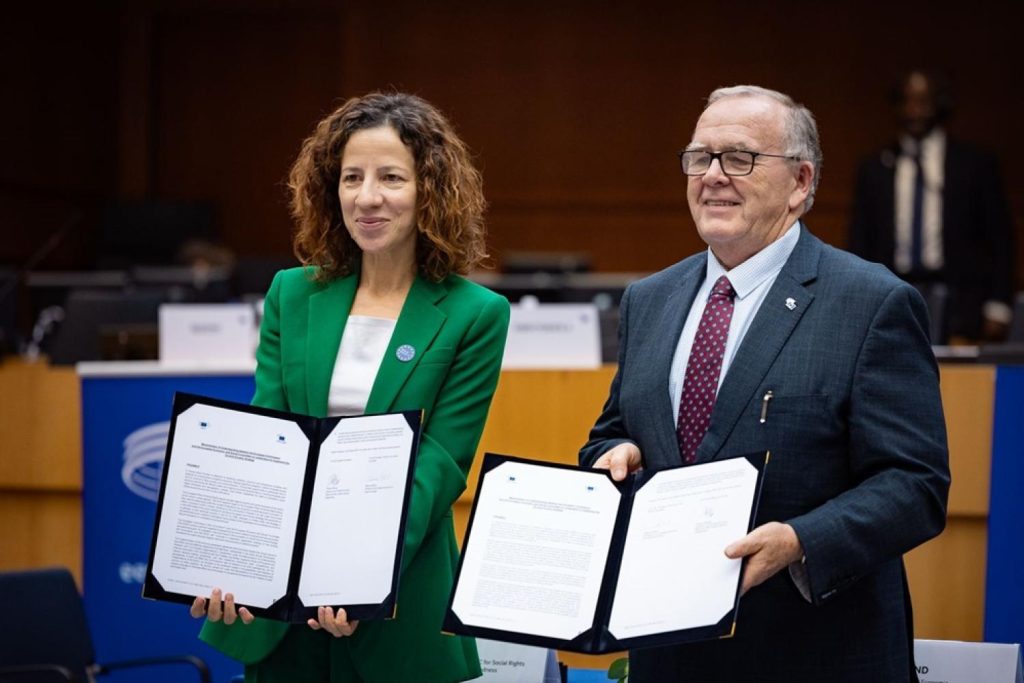
Furthermore, on 22 October, during a high-level debate entitled “Eradicating Poverty by 2050”, the EESC and the European Commission signed a Memorandum of Understanding to strengthen cooperation on implementing the EU Anti-Poverty Strategy and the European Child Guarantee. The agreement provides for annual plenary debates and prioritises initiatives relevant to employers, workers and civil society organisations. It also stresses that people experiencing poverty must be involved in shaping policies that affect them.
EESC President Séamus Boland called for political commitments to be translated into concrete action. The discussion highlighted the need for measures addressing employment, income, education, housing, healthcare and essential services. Participants also called for measurable targets and regular assessments of progress in Member States.
Carlos Susías, President of the European Anti-Poverty Network (EAPN), stressed that the strategy’s commitments must also be reflected in the EU’s 2028–2034 Multiannual Financial Framework. Without adequate funding, achieving its objectives will be difficult.
The discussion also focused on intergenerational poverty. Participants emphasised the importance of early investment in children and families, quality education and care, adequate income support and affordable housing. Attention was also drawn to the risk of poverty among older people, particularly women, persons with disabilities and those with interrupted or unstable working careers.
The discussions highlighted that tackling in-work poverty is inseparable from collective bargaining, fair pay and stronger social protection.
What do these developments mean for trade unions?
The issues discussed at the EESC plenary session confirm that social policy and workers’ interests must be an integral part of economic decision-making in Europe.
For trade unions, these developments provide an opportunity to draw on priorities established at European level to advocate for stronger collective bargaining, meaningful social dialogue, better protection for workers during the digital transition and concrete measures to tackle in-work poverty.
European competitiveness, technological progress and economic growth matter only when workers also benefit from their results. Social dialogue must therefore be more than a formality: it must be a genuine means of finding solutions that balance economic needs with people’s right to decent work.
Source: eesc.europa.eu
In the photo: European Commission Executive Vice-President Roxana Mînzatu and EESC President Séamus Boland sign a memorandum on cooperation to tackle poverty, 22 October 2026. Photo credits: eesc.europa.eu.