
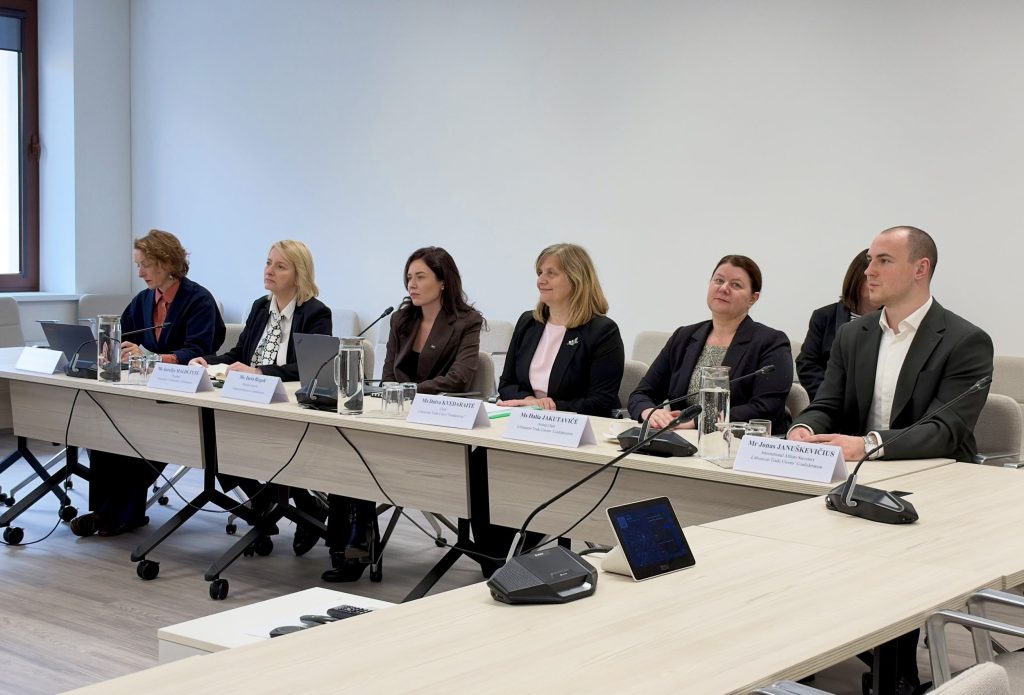
On 21 October, Gilbert F. Houngbo, Director-General of the International Labour Organization (ILO), visited Vilnius. A meeting with social partners – representatives of employers’ organisations and trade unions – was held at the Ministry of Social Security and Labour. Discussions focused on challenges facing the world of work, social dialogue and the ILO’s role in protecting workers’ rights.
The Lithuanian Trade Union Confederation (LPSK) was represented by its Acting President, Dalia Jakutavičė, and International Relations Secretary, Jonas Januškevičius.
LPSK representatives raised concerns about the ILO’s financial stability and its ability to fulfil its mission in the future. Unpaid contributions from member states pose a risk to the organisation’s capacity to monitor the implementation of international labour standards, protect workers’ rights and provide assistance to trade unions and other social partners. Public reports indicate that member states owe the organisation more than CHF 260 million.
The meeting also addressed the ILO’s support in the areas of labour migration and platform work. For Lithuanian trade unions, it is important that the organisation retains its capacity to provide expertise and training to member states and social partners, particularly in implementing new international labour standards.
Particular attention was paid to the relationship between ILO conventions and European Union law. LPSK emphasised that these legal frameworks complement one another. ILO conventions establish minimum international standards for the protection of workers and provide mechanisms for monitoring their implementation. This is particularly important for protecting the rights of migrant workers and people working through digital labour platforms.
During the meeting, ILO Director-General Gilbert F. Houngbo expressed support for the importance of representing and strengthening workers’ rights. Workers are often the weaker party in employment relationships, making it essential to ensure effective protection of their rights, strengthen the role of trade unions and enable workers to defend their interests collectively.
The meeting also highlighted the ILO’s ongoing organisational reform, which aims to use resources more efficiently, review operational priorities and strengthen technical capacity at the regional level. At the same time, a key question remains: how can financial and structural changes be implemented without undermining the organisation’s core mission of protecting workers’ rights and promoting social justice?
The visit was particularly significant, as the head of the ILO had last visited Lithuania 12 years ago. The ILO is the only specialised agency of the United Nations operating on a tripartite basis, bringing together representatives of governments, employers and workers to promote social justice and decent work for all.
The organisation plays an important role in shaping international labour standards, promoting social dialogue and helping countries build a fairer, safer and more sustainable world of work.
Lithuania became an ILO member in 1921 and has been elected for the third time as a full member of the ILO Governing Body for the 2024–2027 term. The ILO currently has 187 member states.