
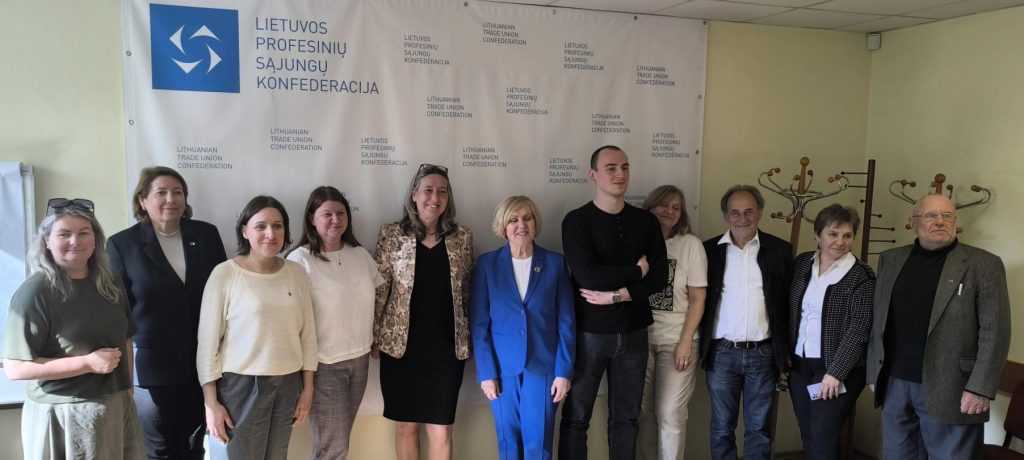
On 11 May, a meeting took place between Lithuanian trade union representatives and Lucie Studničná, President of the Workers’ Group of the European Economic and Social Committee (EESC). The meeting focused on trade union priorities for Lithuania’s upcoming Presidency of the Council of the European Union (EU), strengthening workers’ rights and social protection in the European Union, and trade union expectations towards EU policymakers and the European Commission.
The discussion reviewed Lithuania’s political and economic situation, the challenges facing social dialogue, and issues related to workers’ social protection.
Participants discussed the principles and criteria for setting the minimum monthly wage, as well as current developments related to the transposition of the Pay Transparency Directive into national legislation.
Trade union representatives emphasised the need to strengthen the collective bargaining system in Lithuania. One of the initiatives discussed was the inclusion of a provision in public procurement rules giving priority to companies that have collective agreements and active trade unions. According to trade union representatives, this would encourage socially responsible business practices and contribute to better working conditions.
Considerable attention was also devoted to the situation of migrant workers in Lithuania. It was noted that although employers face very strict requirements when hiring migrants — for example, the obligation to provide accommodation — in practice migrants are often housed in poor conditions. Due to their dependence on employers, they are frequently afraid to report violations or join trade unions.
Attention was also drawn to the fact that if a migrant worker loses their job and fails to find another employer within one month, they may face deportation. Trade union representatives stressed that the growing number of migrant workers in certain sectors also creates risks of social dumping — currently, migrants make up around 7.5% of all workers in Lithuania.
The discussion also highlighted the need for the swift adoption of the Traineeships Directive. According to trade union representatives, many traineeships are currently unpaid or insufficiently paid, making it essential to guarantee at least a minimum income for trainees.
The meeting also addressed the increasingly widespread use of artificial intelligence in workplaces, especially in the public sector. Trade union representatives pointed to the additional risks this creates for workers, including work intensification, increased monitoring, possible discrimination, and the need to ensure clear regulation protecting workers’ rights when AI solutions are introduced in the workplace.
During the meeting, Lucie Studničná was also informed about the situation in the nursing sector and the need to address, at European level, issues related to safe staffing levels for nursing professionals, nurses’ workloads, and appropriate regulation of advanced nursing practice. It was emphasised that clear EU-level Council recommendations on the regulation of advanced nursing practice are necessary to help ensure high-quality healthcare services, patient safety, and better working conditions for nursing professionals across Europe.
Participants agreed that Lithuania’s upcoming Presidency of the Council of the European Union should become an opportunity to raise issues related to workers’ rights, social dialogue, and social justice more actively at the European level.
The meeting was also attended by Yolanda Torres Revenga, Head of Unit of the EESC Workers’ Group Secretariat; Kristina Krupavičienė, Chairperson of the Lithuanian Trade Union “Solidarumas”; representatives of the organisation — Ričardas Garuolis, Daiva Kvederaitė and Jovita Pretzsch; Dalia Jakutavičė, Acting Head of the Lithuanian Trade Union Confederation (LPSK); Jurga Subačiūtė-Žemaitienė, Deputy Chairperson of the Lithuanian Industrial Trade Union Federation; Aleksandras Posochovas, Chairperson of the Lithuanian Services Sector Trade Union; Irena Petraitienė, Chairperson of the Lithuanian Trade Union of Civil Servants, Budgetary and Public Sector Employees; Romualdas Nemanius, Chairperson of the Lithuanian Federation of Public Service Trade Unions; Birutė Daškevičienė, Chairperson of the Achema Workers’ Trade Union; Jonas Januškevičius, International Relations Secretary of LPSK; and Jūratė Čilinskaitė, Public Relations Specialist at LPSK.