
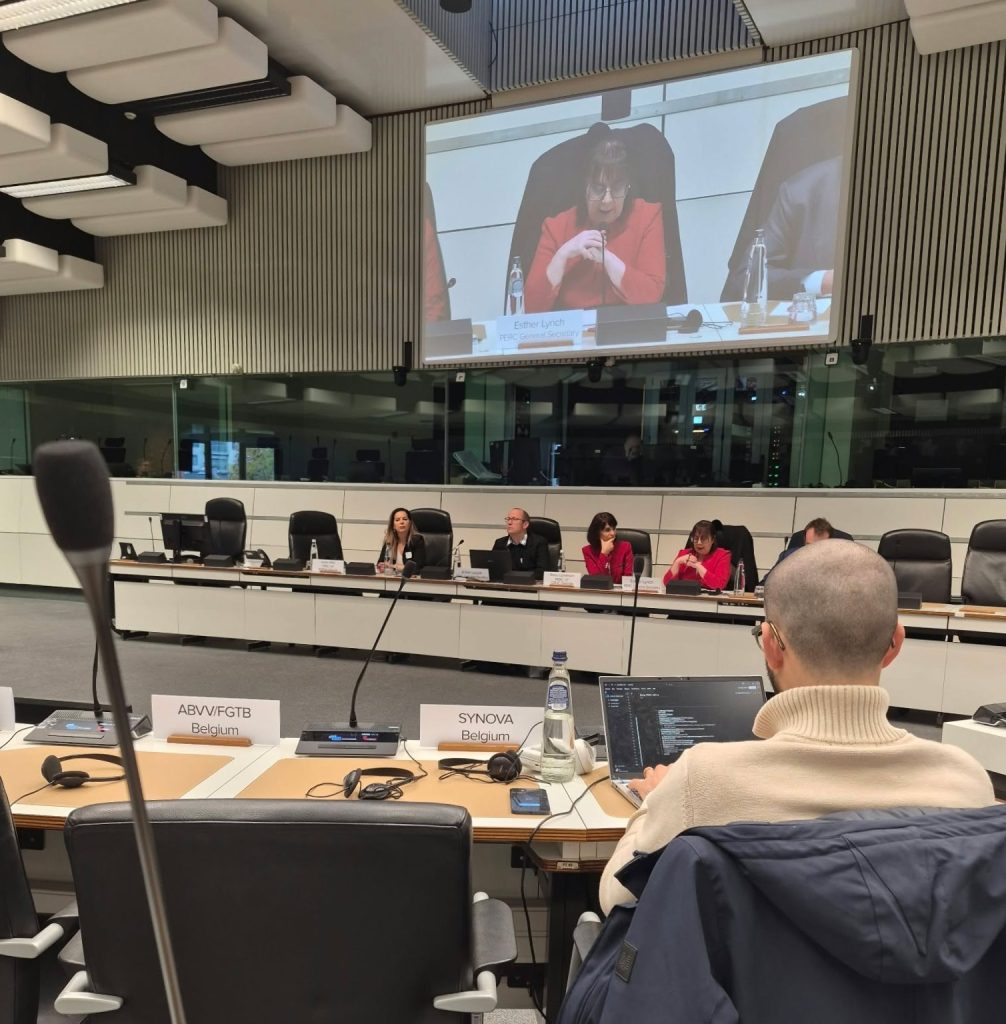
On 19 November, the 24th meeting of the Executive Committee of the Pan-European Regional Council (PERC) was held in Brussels. The meeting addressed key issues facing the European trade union movement, challenges related to the protection of workers’ rights, and future priorities. The Lithuanian Trade Union Confederation (LPSK) was represented by its lawyer, Jonas Gricius.
One of the key highlights of the meeting was the address by Esther Lynch, General Secretary of the European Trade Union Confederation (ETUC), who spoke about the threats facing the trade union movement today and the need to strengthen workers’ representation.
E. Lynch drew attention to rapidly changing forms of work and the challenges they pose to social dialogue, the issue of modern slavery, the threats posed by artificial intelligence to workers, rising poverty and social vulnerability. She stressed the important role of trade unions in addressing these challenges by taking active action, strengthening workers’ representation and ensuring that social dialogue keeps pace with changes in the labour market.
The meeting also addressed current issues facing the international trade union movement and preparations for the forthcoming congress in May.
Peace, Social Protection and International Cooperation
A separate part of the agenda focused on peace and resilience. Oscar Enerrot, representing the Olof Palme International Center, presented the European Common Security Report.
The participants also discussed the ITUC’s 2027 work programme and preparations for the organisation’s General Council and Congress.
Discussions also covered the activities of the International Labour Organization (ILO) and reforms of social protection systems.
The case of Romania was presented as an example concerning the implementation of ILO Convention No. 102 on Minimum Standards of Social Security. Following a complaint by Romanian trade unions regarding a social security reform that shifted most of the contribution burden onto workers, the ILO Committee of Experts found that workers’ contributions towards financing certain social security benefits exceeded the 50% limit set by the Convention. The ILO called on the Romanian Government to ensure compliance with the Convention, carry out the necessary financial assessments before changing social security contributions, and seek solutions through social dialogue.
Participants reviewed PERC’s 2027 priorities and action plan, including preparations for the PERC General Assembly. The Women’s and Youth Committees presented their activity reports and plans for the coming year. The organisation’s annual activity report, financial situation and financial forecasts for 2027 were also discussed.
What Is PERC and Why Is LPSK’s Participation Important?
PERC is a regional body operating within the structure of the International Trade Union Confederation (ITUC). It brings together trade union organisations from across Europe and neighbouring regions, strengthens their cooperation and coordinates joint action to protect workers’ rights, promote democracy and social justice, and strengthen quality social dialogue.
LPSK actively participates in PERC’s activities, contributing to joint discussions, the development of common positions and international trade union cooperation. This provides an important opportunity to represent the interests and concerns of Lithuanian workers at international level, exchange experience with trade unions from other countries and work together to find solutions to shared challenges.
Labour market changes, technological threats, poverty and social vulnerability do not stop at national borders. This makes international trade union solidarity and joint action increasingly important.