
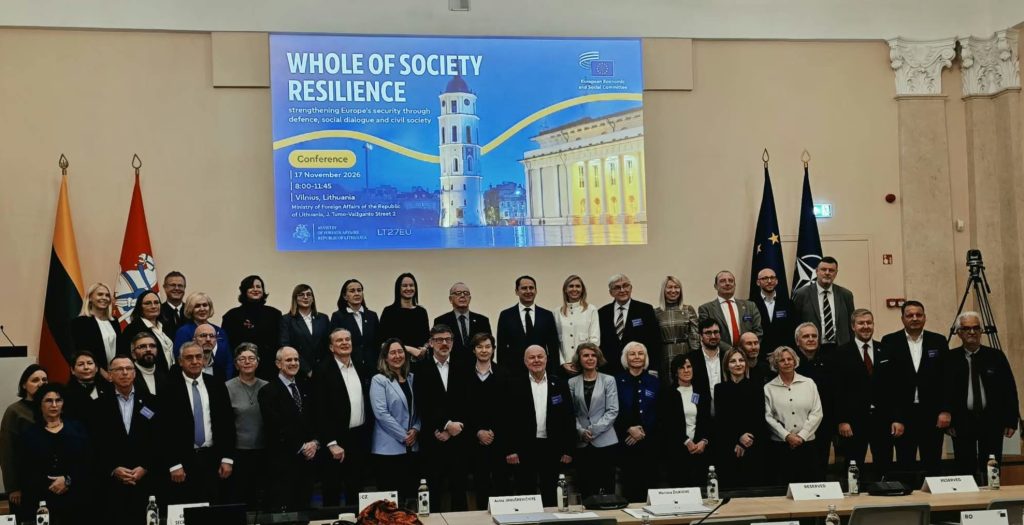
On 17 November, a conference entitled “Comprehensive Resilience: Strengthening European Security through Defence, Social Dialogue and Civil Society” was held in Vilnius, organised by the European Economic and Social Committee (EESC).
The conference was attended by Dalia Jakutavičė, Acting Chair of the Lithuanian Trade Union Confederation (LPSK), and Jurga Subačiūtė-Žemaitienė, Vice President of the Lithuanian Industry Trade Union Federation (LPPSF), who is an EESC member representing workers’ interests on the Committee.
The conference explored a broad understanding of European security, ranging from defence capabilities and crisis preparedness to economic stability, social protection, social dialogue and the role of civil society in strengthening national resilience.
Social Security – an Integral Part of National Resilience
Speaking at the conference, Minister of Social Security and Labour Inga Ruginienė emphasised that national security depends not only on a country’s ability to respond to external threats, but also on the social security of its people.
“People who have decent jobs, stable incomes, can provide for their families and trust public institutions feel more secure and are better prepared to contribute to their country’s well-being and security,” the Minister stated.
This message is particularly relevant to workers’ representatives. Decent work, fair wages, proper working conditions, social protection and the opportunity to participate in decision-making are essential not only for individual well-being but also for the stability of society as a whole.
Social Dialogue – a Key Foundation of a Resilient Society
The discussion featured Andrius Kubilius, European Commissioner for Defence and Space; Vilmantas Vitkauskas, Head of the National Crisis Management Centre; Tomas Godliauskas, Head of the “Total Defence” Association; Ieva Dirmaitė, representative of the Lithuanian Red Cross; and Edgaras Geda, Adviser at the Fire and Rescue Department. The discussion was moderated by Gaja Šavelė, EESC member and Director of the National NGO Coalition.
The Lithuanian Ministry of Social Security and Labour also presented one of Lithuania’s priorities for its Presidency of the Council of the European Union in the first half of 2027: strengthening social security in response to demographic challenges and enhancing society’s resilience to long-term changes.
Particular attention will be given to creating quality jobs, ensuring adequate social protection, improving access to public services and promoting equal opportunities. Other key issues include workers’ mental health, the prevention of psychosocial risks and empowering young people in the digital age.
Social dialogue and the involvement of workers, employers and civil society organisations will be essential to achieving these objectives. Only by engaging different groups in society can decisions be made that reflect people’s real needs and strengthen public trust in institutions.
The EESC brings together representatives of employers, workers and civil society organisations and provides opinions to EU institutions on EU policies and legislation. The Committee consists of 329 members, nine of whom represent Lithuania.
The conference and the EESC Bureau meeting in Vilnius were organised as part of Lithuania’s preparations for its Presidency of the Council of the European Union in the first half of 2027.