
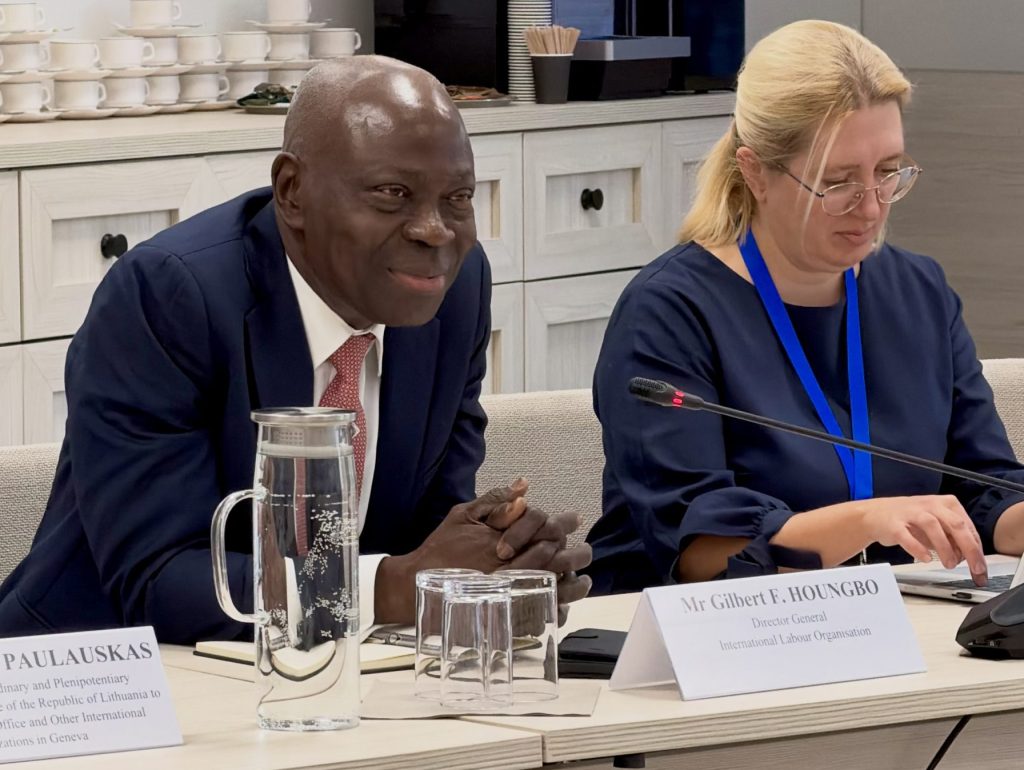
At its meeting in Geneva on 16 November, the Governing Body of the International Labour Organization (ILO) re-elected its current Director-General, Gilbert F. Houngbo, for a second five-year term. His new term will begin on 1 October 2027 and run until 30 September 2032.
In the secret ballot, Houngbo received 51 votes, while five members of the Governing Body abstained. Before the vote, Spain’s Minister of Labour, Yolanda Díaz Pérez, and the candidate from Peru, Javier González-Olaechea Franco, withdrew their candidacies. The Spanish candidate explained that her decision was motivated by a desire to avoid divisions within the international trade union movement.
Key priorities for the second term
Gilbert F. Houngbo has led the ILO since 2022. He is the Organization’s 11th Director-General and the first African to hold this position.
Houngbo highlighted the impact of artificial intelligence on the labour market as one of the key challenges ahead. He stressed that the ILO must be at the forefront of these discussions to ensure that technological progress serves people, rather than the other way around.
Another major challenge is the Organization’s financial situation. The ILO is facing a funding crisis because the United States, traditionally its largest financial contributor, has withheld some of its contributions. As a result, the Organization has warned that it may have to reduce its workforce.
On the day of the election, signs of staff protests against planned job cuts could also be seen at the ILO headquarters in Geneva.
Financial difficulties have also affected the Organization’s leadership structure. In April, a US official was appointed as the ILO’s Deputy Director-General, but the appointment was rescinded in June due to unpaid US contributions. The position remains vacant.
Following his re-election, Houngbo emphasised that tripartism – cooperation between workers, employers and governments – remains one of the fundamental principles of the ILO. According to him, differences of opinion should not prevent the parties from working together to find solutions based on dialogue, mutual respect and the common interest.
It is worth recalling that Gilbert F. Houngbo met with representatives of Lithuanian social partners in Vilnius this October.
Representatives of the Lithuanian Trade Union Confederation (LPSK) raised concerns about the ILO’s financial stability and its ability to fulfil its mission in the future. Discussions also addressed the ILO’s support in the areas of labour migration and platform work, the implementation of international labour standards, and the relationship between ILO Conventions and European Union law.
Founded in 1919, the ILO is the oldest specialised agency of the United Nations. It brings together 187 Member States and works to promote social justice, decent work and the protection of workers’ rights worldwide.
Source: ilo.org and reuters.com.