
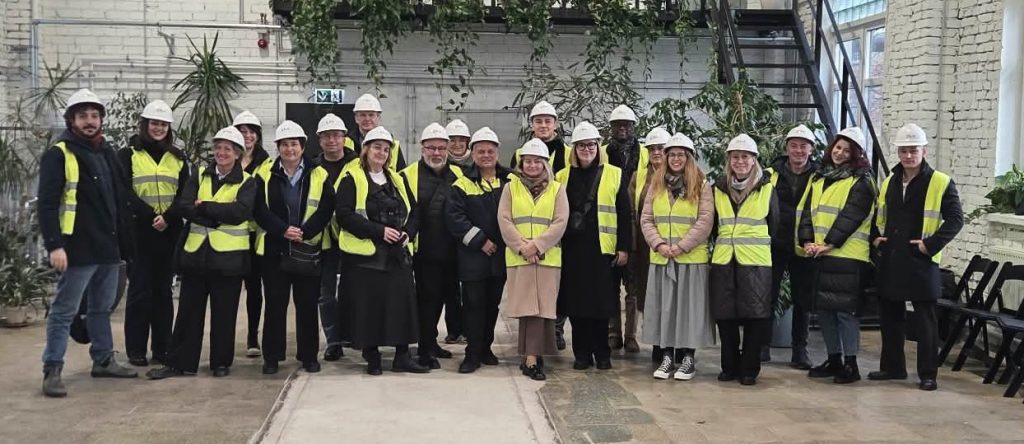
On 4–6 November, the European Trade Union Institute (ETUI) seminar “The New Ecosocial Contract” took place in Vilnius, bringing together trade union representatives from Lithuania and other European countries to discuss the links between climate change, social justice, employment and workers’ rights.
During the three-day seminar, participants explored what the new ecosocial contract means, why it matters for workers and trade unions, and how to ensure that the green transition is not only environmentally sustainable but also socially just.
On the first day, Jonas Januškevičius, International Relations Secretary of the Lithuanian Trade Union Confederation (LPSK), introduced the concept of the new ecosocial contract. Through discussions and working groups, participants shared their perspectives and examined the significance of this contract for workers and the role trade unions should play in its implementation.
A practical example was the “Employment, Climate and Social Economy Pact” in the Emilia-Romagna region of Italy. Sabina Porcelluzzi from the FISAC CGIL trade union presented the region’s experience, demonstrating how social dialogue can help reconcile employment, climate policy and social economy objectives.
On the second day, seminar participants visited AB “Miesto gijos”, where they met with trade union representatives and learned about the company’s activities. The visit also provided an opportunity to discuss workers’ representation and social dialogue.
Another important part of the seminar was a presentation on the case of AB “Achema”, a Lithuanian fertiliser manufacturer. Birutė Daškevičienė, Chair of the company’s trade union, and Simona Misiūnienė, a member of its trade union council, shared their first-hand experience and insights, prompting discussions on the challenges of industrial transformation, protecting workers’ interests and safeguarding social guarantees.
During the working groups, participants explored arguments that trade unions can use to promote the new ecosocial contract and raise ecosocial awareness among workers and society as a whole.
One key message emerged throughout the seminar: achieving climate goals must not come at the expense of workers’ rights. The green transition must go hand in hand with social dialogue, workers’ involvement in decision-making, the creation of quality jobs, opportunities for reskilling and retraining, and the protection of social guarantees.
Trade unions have a vital role to play in this process: ensuring that workers’ voices are heard as the economy and labour market evolve, and that environmental and social objectives are pursued together.