
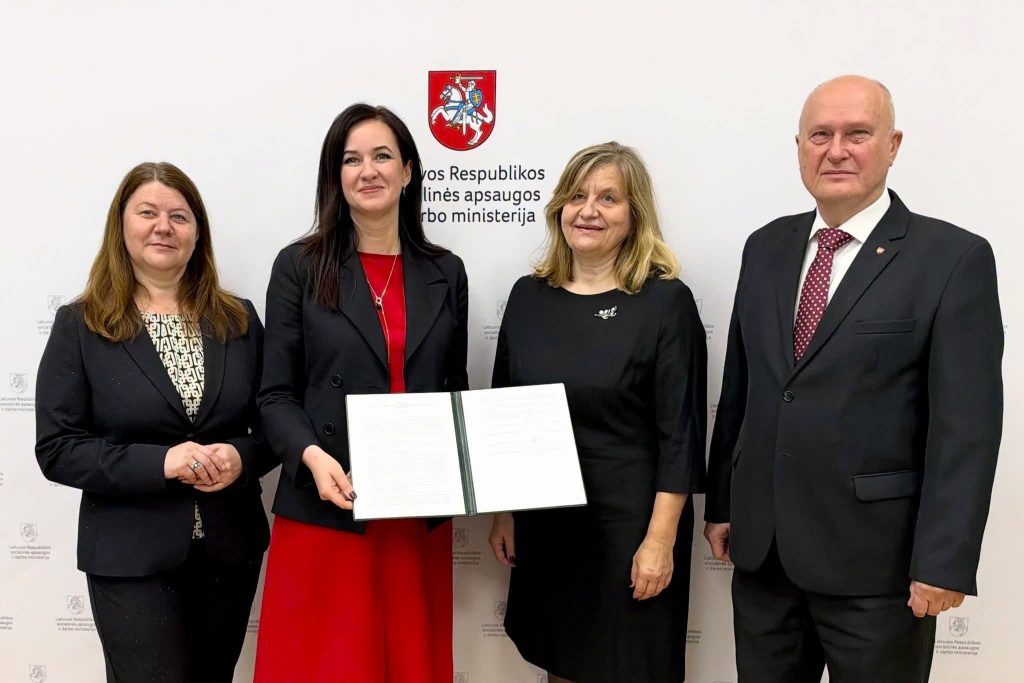
On 9 October, the updated 2026–2028 National Collective Agreement was signed. Under the agreement, the basic amount used to calculate official salaries will increase by €45 in 2027, rising from €1,798 to €1,843. The change will affect more than 200,000 employees whose salaries are calculated on the basis of this amount.
The updated agreement was signed by Inga Ruginienė, Minister of Social Security and Labour, Arvydas Dambrauskas, Chair of the Republican Joint Trade Union, Dalia Jakutavičė, Acting President of the Lithuanian Trade Union Confederation (LPSK) and Daiva Kvedaraitė, President of the Lithuanian Trade Union “Solidarumas”.
Higher Basic Amount – An Important Result for Workers
The increase in the basic amount will affect the salaries of civil servants, employees of budgetary institutions, statutory officers, judges, military personnel and other employees whose pay is calculated using this amount.
In 2027, the basic amount will increase by €45, or approximately 2.5%. The amount will be submitted to the Seimas for approval as part of the 2027–2029 state budget.
Dalia Jakutavičė, Acting President of the Lithuanian Trade Union Confederation, emphasises that the agreement demonstrates the tangible results that can be achieved through social dialogue.
“An agreement on a higher basic amount shows that social dialogue can deliver tangible results for workers – supporting wage growth and recognising the value of the work performed in the public sector,” says Dalia Jakutavičė.
Additional Benefits for Trade Union Members Preserved
The updated National Collective Agreement preserves additional benefits for members of the trade unions that signed it. The provisions also apply to eligible trade union members working in state-owned or municipally owned companies.
The key benefits include:
- Two additional paid days off per year for self-development or volunteering. The updated agreement clarifies that these days are paid at the employee’s average wage. This benefit applies not only to employees of budgetary institutions but also to eligible trade union members working in state-owned or municipally owned companies.
- Educational leave. Trade union members working in budgetary institutions are entitled to up to 10 working days of educational leave per year at 100% of their average wage, or up to 20 working days at 50% of their average wage.
- Up to five working days per year for health improvement for trade union members working in budgetary institutions.
These benefits represent additional rights secured through collective bargaining and trade union action. The updated agreement ensures that they remain in place in the coming years.
Strong Social Dialogue Delivers Tangible Benefits for Workers
The National Collective Agreement is an important instrument of national social dialogue. It aims to reconcile the interests of workers, employers and the state, strengthen workers’ representation and establish concrete measures to improve working conditions.
The 2026–2028 National Collective Agreement is in force from 1 January 2026 until 31 December 2028. The benefits provided under the agreement are intended for approximately 75,000 trade union members.
The renewal of the agreement once again demonstrates that, through national-level negotiations, trade unions can secure not only better pay but also additional benefits that help workers balance employment, education, self-development and their health.