
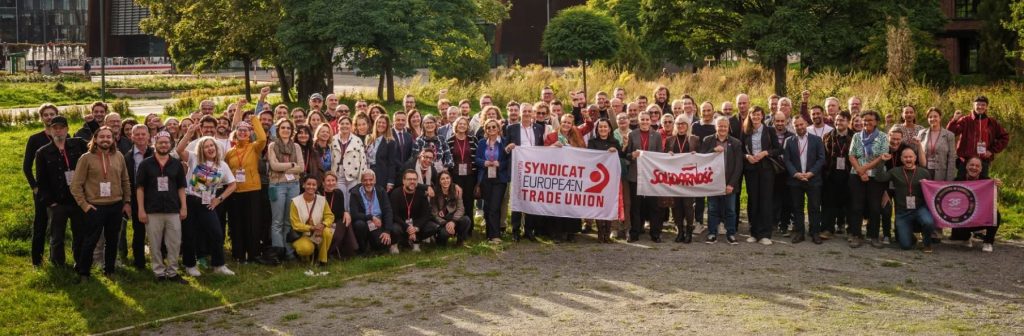
On 24–25 September, the fifth Trade Union Forum on Platform Work (Trade Union Platforum) took place in Gdańsk, Poland, bringing together around 140 participants from various countries and organisations. This year’s event was particularly significant, as all European Union Member States must transpose the Platform Work Directive into national law by 2 December.
Held under the motto “Together for a Fair Deal for Workers!”, the forum took place in a symbolic venue – the historic BHP Hall at the Gdańsk Shipyard. This was where meetings of the “Solidarność” movement took place, becoming an important part of Poland’s restoration of independence and broader democratic changes across Europe. The venue served as a reminder of the importance of workers’ unity and collective action, not only for industrial relations but also for the future of society as a whole.
The event was opened by representatives of the European Trade Union Confederation (ETUC), the Friedrich Ebert Foundation (FES), and the Polish trade unions OPZZ and “Solidarność”.
The forum brought together representatives of trade unions, labour inspectorates, governments, the European Commission and the European Parliament. Over two days of discussions and practical workshops, participants addressed the key challenges facing the platform economy, including fairness and transparency, algorithmic management, workers’ data protection, the transposition of the Directive, and the organisation of platform workers.
The Lithuanian Trade Union Confederation (LPSK) was represented by its International Relations Secretary, Jonas Januškevičius, who presented his colleagues with an overview of the specific characteristics and regulatory gaps in individual employment relationships.
Transposing the Directive – Not a Formality, but an Opportunity to Transform the Labour Market
The first day of the forum focused largely on the progress being made by Member States in transposing the Platform Work Directive. Discussions emphasised that countries must not only implement the Directive on time but also adopt an ambitious approach that ensures genuine protection for workers.
Otherwise, the consequences will affect not only platform workers but also the principles of fair competition and the EU single market.
Platform workers increasingly face bogus self-employment, algorithmic management and decisions made by artificial intelligence systems that directly affect their working conditions, income and access to work. Although decisions are made by technological systems, workers often have no way of understanding how they are made, challenging them or contacting a responsible person.
Examples presented at the forum also highlighted the tangible financial consequences of algorithmic management. In the United Kingdom, platform-based drivers lost an average of approximately £5,000 per year due to algorithmic management compared with previous dispatching mechanisms, while in the Netherlands, the figure was around €7,000.
However, financial losses are only one side of the problem. Workers are burdened with disproportionate responsibility for the quality of services and the work equipment they often have to purchase and maintain at their own expense. At the same time, opportunities to contact a platform representative directly are extremely limited, with chatbots frequently responding to workers’ enquiries. Under such circumstances, workers’ voices remain unheard, and genuine collective bargaining becomes virtually impossible.
Labour Inspectorates and Trade Unions – Essential to Delivering Real Change
An important part of the forum’s discussions focused on the responsibility of decision-makers and the role of labour inspectorates. Participants stressed that transposing the Directive into national law must be accompanied by sufficient institutional capacity, expertise and resources to ensure that the new provisions are effectively enforced in practice.
Labour inspectorates and trade unions will be key mechanisms in ensuring that workers’ rights do not remain merely words on paper.
The second day of the forum focused on practical solutions and the exchange of good practices. Workshops addressed organising migrant workers into trade unions, digital investigations and accessing workers’ data, the relationship between the Platform Work Directive and ILO Convention No. 193, as well as ways to prevent unfair contractual practices used by platforms.
A New Opportunity for Trade Unions to Expand Their Activities
Forum participants emphasised that the forthcoming implementation of the Directive is not merely a legal process, but also an important opportunity for trade unions to strengthen their activities and organise platform workers.
Many platform workers currently work in isolation, without opportunities to unite and collectively negotiate their working conditions. Therefore, trade unions must reach out to these workers, help them understand their rights and create opportunities for them to organise into trade unions.
The forum once again served as a reminder that technological progress must not become a means of circumventing workers’ rights, and that the digital economy cannot be built at the expense of workers’ security, dignity and social dialogue.