
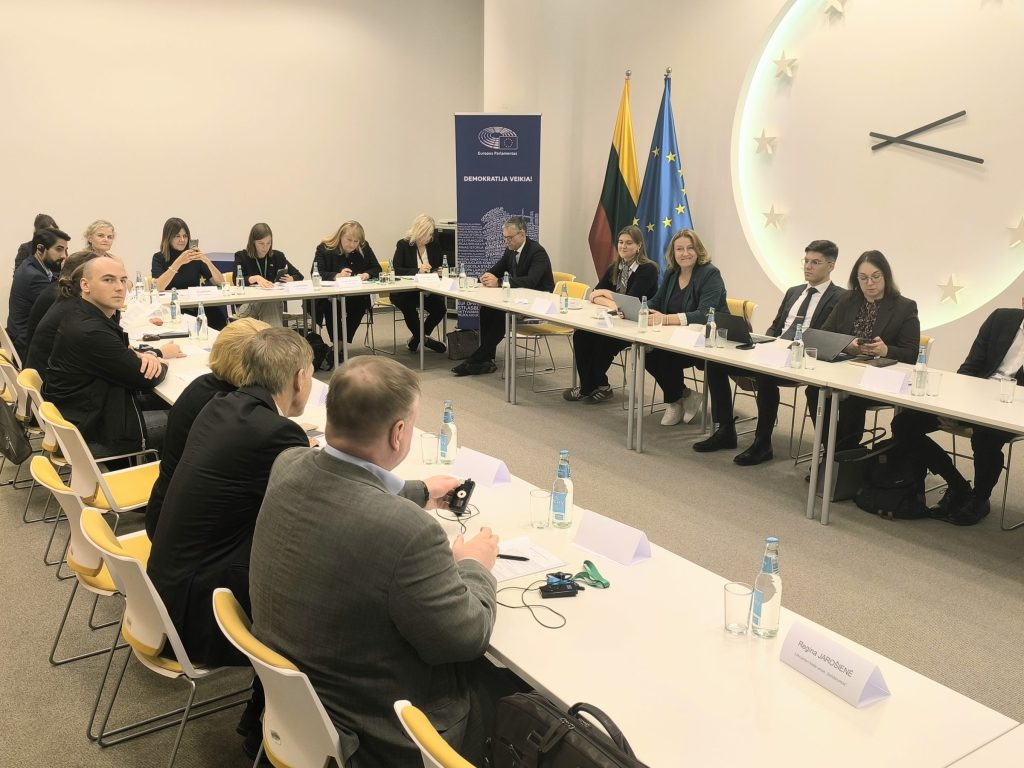
On 22 September, a meeting was held at the House of Europe in Vilnius between the European Parliament’s Committee on Employment and Social Affairs (EMPL) delegation and representatives of Lithuanian trade unions, employers and business organisations. The discussions focused on the situation in the Lithuanian labour market, workers’ rights and key employment and social policy issues.
The European Parliament delegation was led by Li Andersson, Chair of the EMPL Committee, with MEPs Idoia Mendia and Vilija Blinkevičiūtė also taking part.
The Lithuanian Trade Union Confederation (LPSK) was represented by Acting President Dalia Jakutavičė, Chair of the Civil Servants’ Trade Union Irena Petraitienė, LPSK International Relations Secretary Jonas Januškevičius, and Public Relations Specialist Jūratė Čilinskaitė.
EU legislation shaping workers’ everyday lives
One of the key topics of the discussion was EU legislative initiatives and their implementation in Lithuania. The participants discussed directives that are particularly relevant to workers and the labour market, including the Pay Transparency Directive, the Platform Work Directive and the Directive on Adequate Minimum Wages in the European Union.
The meeting also addressed the principles for setting the minimum wage in Lithuania, as well as workers’ retraining and upskilling.
LPSK representatives stressed that, as the labour market is changing rapidly, investment in workers’ skills is becoming increasingly important. Age should not be a barrier to participation in the labour market – skills and appropriate qualifications should be the key criteria.
Social dialogue must become a value
LPSK Acting President Dalia Jakutavičė highlighted the importance of social dialogue.
“We want social dialogue to become a genuine value, rather than merely a formal process. Workers’ voices must not only be heard but genuinely taken into account when decisions are made. This is also an important condition for achieving the competitiveness we are seeking.” said D. Jakutavičė.
The meeting also addressed workers’ right to strike and the practical obstacles to organising strikes in Lithuania. From the trade unions’ perspective, the right to strike must not only be enshrined in legislation but also be genuinely accessible and effective in practice.
Public money should support quality jobs
Discussing EU funding and public procurement, trade union representatives stressed that public money should not be allocated solely on the basis of the lowest price or the number of jobs created.
The quality of jobs must also be taken into account: working conditions, wages, the sustainability of jobs, opportunities for worker representation and the employer’s approach to social dialogue.
The trade unions’ position is that support for businesses should not be unconditional. When allocating state or EU funding, it should be assessed whether companies respect workers’ rights, engage in social dialogue and conclude collective agreements.
Public money should help create quality jobs. Public funds should not support companies that compete at the expense of workers.
How can people remain in the labour market?
Considerable attention was also devoted to the future of the Lithuanian labour market. Like many European countries, Lithuania is facing labour shortages, an ageing population and rapid technological change.
LPSK stressed that the response to these challenges should not be limited to simply trying to keep people in the labour market for as long as possible through unsustainable measures. Instead, the conditions must be created for people to remain in employment by investing in skills, adapting workplaces, ensuring occupational safety and health, and providing greater flexibility in working time and workload at different stages of working life.
“We need to create conditions in which people can and want to work longer – with up-to-date skills, working conditions that protect their health, and a genuine choice over the workload with which they continue their working lives,” D. Jakutavičė emphasised.
The meeting with the European Parliament’s EMPL Committee delegation provided an important opportunity to present the views of Lithuanian workers and trade unions directly to Members of the European Parliament and to discuss how EU policies can contribute to stronger workers’ rights, better-quality jobs and stronger social dialogue in Lithuania.